
AI Is Re-Pricing Labor and Unbundling Software: Why the New Moat Is Workflow, Trust, and Proof

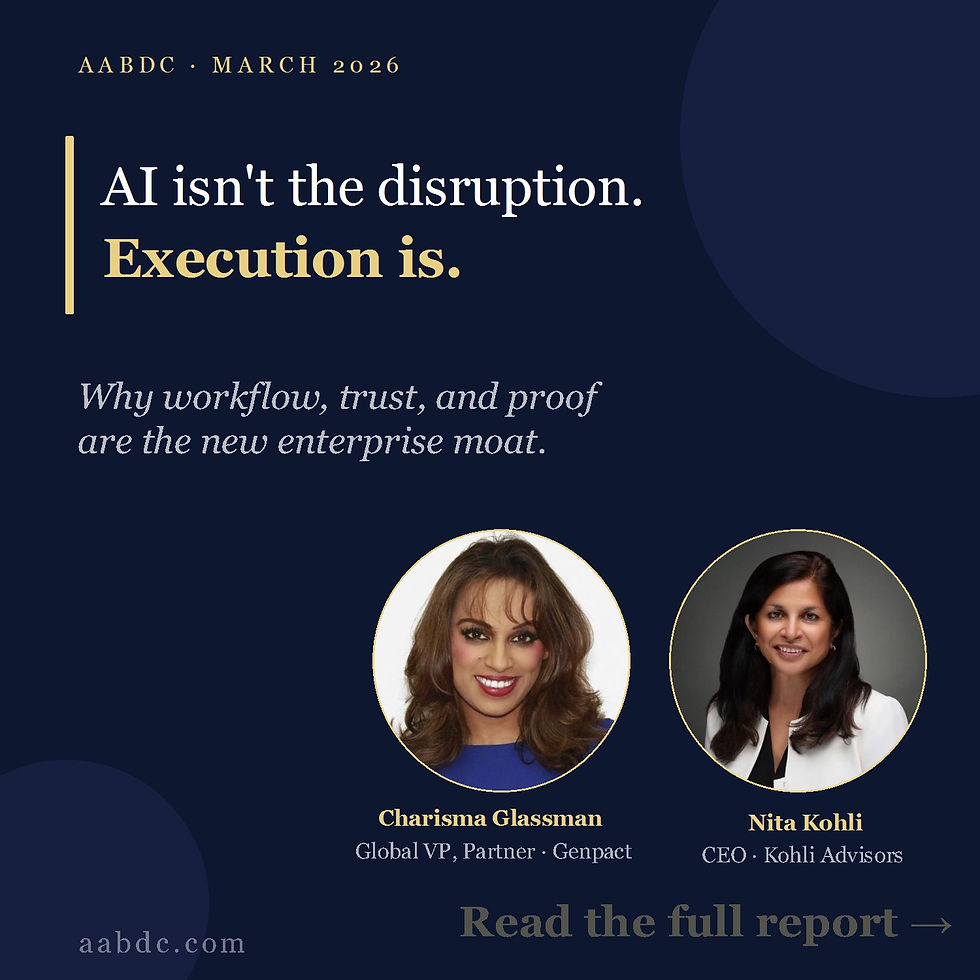
AI is doing two things at once: it’s re-pricing labor and unbundling software. In plain terms, the economics of “how work gets done” are shifting fast- and the value is migrating away from static product features toward outcomes embedded directly in workflows.
Here’s the contrarian truth: AI won’t primarily disrupt companies because they “don’t have the right model.” It will disrupt them because they can’t deliver autonomy with reliability. In the AI era, margin will accrue to the firms that can guarantee outcomes, and absorb exceptions without fragility.
We call this the Autonomy Premium: the enterprise earns outsized value when it can move from assisting humans to executing work- without breaking trust.
For the Asian American executive community, this moment lands in a particular way. Many of us operate in high- expectation environments where trust is earned through delivery, often across global teams, complex stakeholders, and reputationally sensitive markets. That lived experience - execution discipline, stakeholder navigation, and a bias toward measurable outcomes- maps directly to what it takes to scale AI without breaking trust.
From Experimentation to Enterprise Capability
The consensus among global leaders, echoed strongly at the India AI Impact Summit 2026, is that the time for isolated AI experiments has passed. Pilots still matter; but they rarely answer the leadership question that matters: Can we hardwire AI into the enterprise in a way that produces repeatable value, with clear accountability and controls? Scaling is the exam.
The leadership question has changed from “Where can we deploy AI?” to “Where can we govern AI well enough to rely on it?” And that’s why AI scale is ultimately an operating model shift: decision rights, escalation paths, control ownership, and metrics that stand up in a boardroom.
AI rarely fails because the model can’t perform; it fails because the work wasn’t redesigned.
This is where a lot of organizations get stuck. They pursue AI as a layer (an assistant) rather than a redesign (a new way the work is executed). The organizations that scale effectively do the opposite: they simplify workflows, define what “good” looks like, and standardize escalation paths so humans and agents can operate together. There’s a simple idea that captures this shift, highlighted in the recent Genpact report:
“There’s no artificial intelligence without process intelligence.”
Genpact’s 2026 report, Autonomy by Design, captures this transition perfectly. The research highlights that the leading enterprises are those reimagining their core processes to move beyond human-led automation toward true autonomy.
For Asian American executives, this "unlearning" of old labor-intensive models is critical. Our community has historically excelled in optimizing complex supply chains and professional services; today, that excellence must be translated into the language of Agentic Operations - systems that move from "AI that generates" to "AI that executes." It also means positioning away from labor arbitrage and location optimization to future focused AI talent hubs in Asia.
The Great Unbundling: Product Features to Outcomes
In many environments we operate in, trust is earned through delivery-across stakeholders, cultures, and often complex global operating models. We are seeing a predictable but rapid market evolution: moving from copilots to agents, and finally to AI-managed services. As autonomy increases, the "Asian American angle" of meticulousness and reliability becomes a competitive moat. That’s an advantage in a world where buyers want proof, not promises.
This shift is forcing a change in business models that can’t be ignored: AI turns product roadmaps into performance obligations. . We are seeing a move toward usage-based pricing, tiered autonomy, and outcome-linked contracts.
This is the new competitive divide: the firms that can price outcomes profitably, because they can manage exceptions, will capture margin. The firms that can’t will quietly subsidize “autonomy” with human clean-up labor.
The Human Element: Insights from McKinsey 2026
While the technology becomes more autonomous, the organization itself must become more human-centric to survive the transition. McKinsey’s State of the Organizations 2026 report highlights a critical paradox: as we automate the "doing," the "being" becomes more important.
The report indicates that 55% of leaders expect exponential productivity gains from successfully building the AI capabilities of employees. For Asian American leaders, who often navigate bicultural environments and value community-driven leadership, this is a natural fit. McKinsey notes:
"To work well, AI needs to be much more than a plug-and-play tool. AI agents and human employees need to collaborate... Breaking through the productivity ceiling requires shifting attention away from structure and toward how work gets done. The biggest payoff lies in radically simplifying and unifying processes across the enterprise."
The New Moat: Trust as a Growth Lever
In a world where high-performance AI models are abundant and commoditized, the "moat" is no longer the code. The moat is distribution, data rights, and, most importantly, trust.
Trust is not a marketing slogan; it is an operational reality. It is built through rigorous data lineage, model monitoring, human-in-the-loop protocols, and robust third-party oversight. At the India AI Impact Summit 2026, this was framed as "All-Inclusive Intelligence." The New Delhi Declaration, endorsed by more than 90 nations emphasizes:
"Advancing secure, trustworthy and robust AI is foundational to building trust and maximizing societal and economic benefits... AI's future will be won not only by billion-dollar firms building frontier models, but by countries and companies that can deploy AI safely at population scale."
In the AI era, trust debt becomes margin debt. When trust is weak, adoption stalls and rework rises. When trust is strong, autonomy scales and cost-to-serve drops. This is where teams get stuck: they treat trust as a communications problem. It’s not. Trust is an operating discipline. If you can’t show model behavior over time- drift, override rates, exception handling, incident response, third-party controls- you don’t have scalable AI. You have a demo.
This "Sarvajana Hitaya" (Welfare for All) approach provides a blueprint for Asian American businesses to ensure their AI deployments are not only efficient but ethically sound and inclusive.
Three Decisions for 2026
As we look toward the remainder of 2026, three specific decisions will separate the leaders from the dabblers:
Where Agents Go First: Choose what you can govern, not what you can demo. Leaders must identify high-friction, high-value workflows- like supply chain reconciliation or retail pricing- that are ready for autonomous agents today.
Defining 'Good': Autonomy requires explicit standards, thresholds, escalation triggers and unacceptable harm. Leadership must set the standards for "good" (the "ground truth") before the agents start running.
Assurance at Scale: Governance sets the pace; assurance is how you scale without fragility. As the Genpact report notes, "Governance sets the pace – and limits – of AI innovation." Building a "Trusted AI Commons" within your own organization is now a prerequisite for growth. Your AI stack is your dependency chain; if you don’t govern the chain, you don’t govern the outcome.
The Path Forward for AABDC
This isn’t about identity as a marketing angle. It’s about leadership context.
Many Asian American executives are already operating in the reality AI creates: complex stakeholder environments, cross-border execution, high expectations of reliability, and the need to earn trust through results. That’s exactly the operating discipline autonomy demands.
The leaders who win will be able to answer- credibly and repeatedly:
What work is being transformed, and what work is being eliminated?
What outcomes are we guaranteeing, and how do we measure them?
What controls prove trust- internally and externally?
What happens when AI is wrong, and who owns recovery?
For the members of the Asian American Business Development Center, the rise of the Autonomous Enterprise is an invitation to lead. By combining the rigorous analytical frameworks found in the McKinsey and Genpact reports with the cultural values of resilience and community highlighted at the India AI Impact Summit, we can define the next decade of business.
Closing Thoughts
AI is unbundling the enterprise and re-pricing work. It’s turning products into outcomes and forcing business models to evolve. The next decade won’t be won by “AI excitement.” It will be won by leaders who redesign work, prove outcomes, and treat trust as an operational capability.
By focusing on people, process redesign, and undeniable proof of value, Asian American businesses will not just participate in the AI revolution, they will architect it.
About the Author

Charisma Glassman is Vice President and Global Head of Retail, Consumer, and E-Commerce Advisory at Genpact, a global consulting firm based in New York. She partners with C-suite leaders at major brands including PepsiCo, McDonald’s, Unilever, L’Oréal, Barclays, Citi, and Morgan Stanley to drive transformation in revenue growth, customer experience, and operational efficiency across global markets.
With over 20 years of experience across retail, consumer goods, financial services, and luxury sectors, Charisma previously held leadership roles at Capgemini and Barclays. A recognized industry voice, she frequently speaks at global conferences and has been featured in Forbes, Fast Company, and VentureBeat. She holds executive credentials from Harvard Business School and NYU.

Nita Kohli is a board advisor, former global executive, and thought leader at the intersection of resilience, governance, and innovation. With over 25 years of experience across global financial institutions, she has led enterprise-wide transformation and resilience strategies for complex organizations.
As CEO and Co-Founder of Kohli Advisors, she advises boards and C-suite leaders on AI governance, operational resilience, and digital transformation. A former CFO and financial controller, she brings a pragmatic, execution-focused approach to strategic change. Nita is the author of Operational Resilience: Beyond the Checklists and was recognized as a 2022 Outstanding 50 Asian Americans in Business awardee. She is also an advocate for advancing women in leadership.

Comments